
30 Character Trait of the Month Ideas (Free Calendar)
Updated: Aug 28
Quick answer: A “character trait of the month” is a simple routine where your whole school focuses on one value — like respect in September or gratitude in November — for four weeks at a time. Below is a ready-to-use 10-month calendar with 30 trait ideas and a quick classroom activity for each, plus how to make the traits actually stick.
Quick disclosure: we run character-building assemblies, so we’re fans of this approach. But the calendar below is completely free to use on its own — no program required.
What is a “character trait of the month”?
It’s a schoolwide rhythm: each month, everyone — principals, teachers, cafeteria staff, students — puts a spotlight on one character word. You introduce it, define it in kid-friendly language, look for it, and celebrate students who show it. The power isn’t any single trait; it’s the repetition and the shared vocabulary that a whole building uses at once.
Why does a monthly character focus work?
Because character is built through intentional, repeated practice — not a one-time talk. The Character.org framework calls for a “comprehensive, intentional, and proactive” approach, and a monthly cadence is one of the easiest ways to deliver that. The underlying skills pay off, too: a meta-analysis of 213 studies and more than 270,000 students found social and emotional learning produced an 11-percentile-point jump in academic achievement, and a 2015 Columbia University analysis found roughly an 11-to-1 return for every dollar invested in SEL.
There’s a behavioral case as well. Roughly one in five students ages 12–18 — about 19% — reported being bullied at school, according to the National Center for Education Statistics. A consistent, schoolwide focus on traits like respect, empathy, and inclusion gives adults a proactive, common language for the exact behaviors that prevent bullying before it starts. If you want the deeper case for gathering the whole school around these values, we made it in our piece on why school assemblies matter.
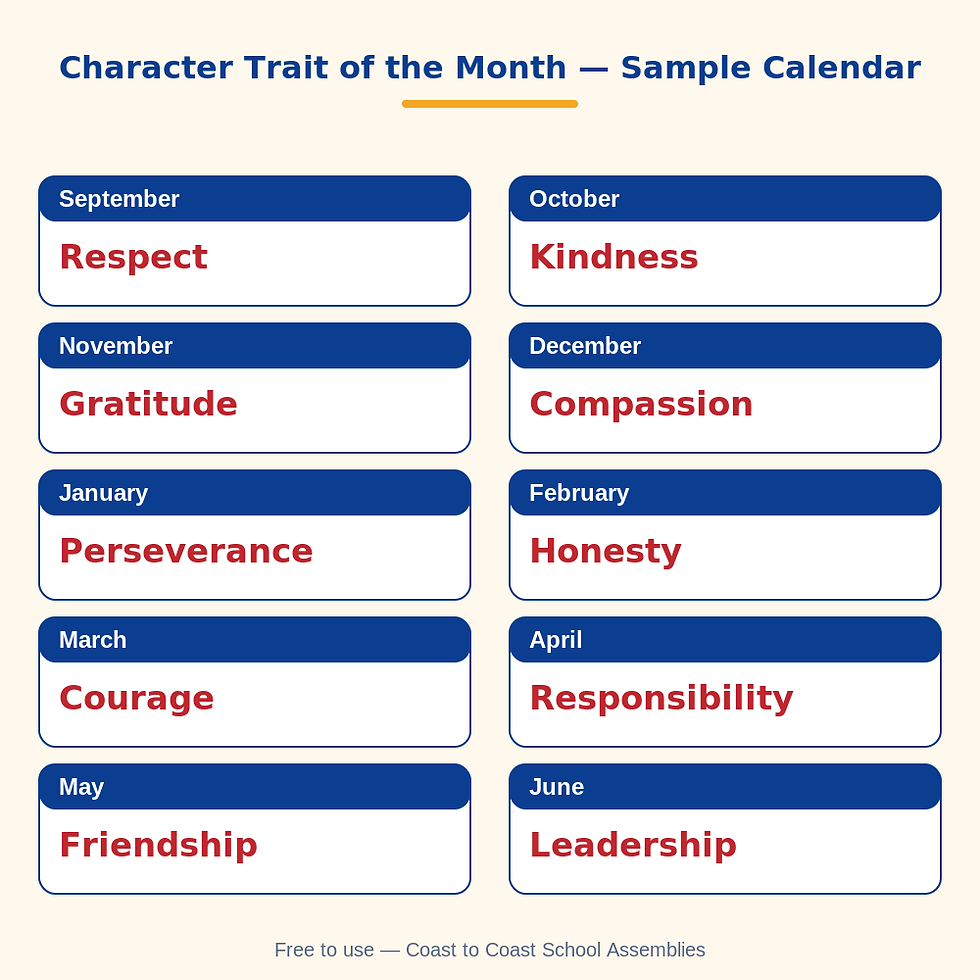
The 30 character trait of the month ideas (free calendar)
Here’s a full school-year plan. Each month has a headline trait plus two companion traits, and one fast activity to launch it. Mix and match to fit your school’s values.
September — Respect (companions: Responsibility, Cooperation). Kick off the year by co-writing a class “respect looks like / sounds like” chart.
October — Kindness (companions: Empathy, Inclusion). Run a “kindness challenge” where each class logs anonymous good deeds toward a schoolwide goal.
November — Gratitude (companions: Generosity, Appreciation). Build a “gratitude wall” in the main hallway that every class adds to.
December — Compassion (companions: Caring, Service). Pick one small service project each class can complete in a single afternoon.
January — Perseverance (companions: Grit, Growth Mindset). Have students set one “hard goal” for the month and track their attempts, not just wins.
February — Honesty (companions: Integrity, Trustworthiness). Read a short dilemma aloud and let students debate the honest choice.
March — Courage (companions: Confidence, Standing Up). Practice “upstander” scripts for what to say when they see someone treated unfairly.
April — Responsibility (companions: Accountability, Self-Control). Give every student one visible classroom job and rotate weekly.
May — Friendship (companions: Teamwork, Loyalty). Assign “mix-it-up” lunch seating one day a week to widen circles.
June — Leadership (companions: Initiative, Citizenship). Let students lead a closing assembly reflecting on the year’s traits.
That’s ten months, thirty traits, and thirty low-prep activities — a complete year you can post on a bulletin board tomorrow. Notice the arc: the fall traits build the community (respect, kindness, gratitude), the winter traits build inner strength (perseverance, honesty, courage), and the spring traits turn those skills outward toward friendship and leadership. You don’t have to follow that order, but a deliberate sequence helps each month build on the last instead of feeling random.
Why these particular traits? They map cleanly onto the core ethical and performance values that Character.org’s framework recommends, and they’re broad enough that every teacher — from kindergarten to eighth grade — can find an age-appropriate example. If your school already uses a set of values or PBIS expectations, keep those words and simply borrow the monthly rhythm and the activities here.
How do you introduce the calendar to staff and families?
A trait of the month works best when the adults are on the same page. Share the full calendar with staff before the year starts so nobody is caught off guard, and give teachers a one-page “look-fors” sheet for each trait. Loop in families, too: a single line in the newsletter — “This month we’re practicing gratitude; ask your child what they’re grateful for” — turns the dinner table into extra practice. Character sticks fastest when the same word is heard at school and at home.
How do you adapt it for older students?
Middle schoolers can roll their eyes at a “word of the month” if it feels babyish, so shift the delivery, not the values. Instead of posters and stickers, use short real-world dilemmas, student-led advisory discussions, and current examples from sports, music, or the news. Let older students help choose the monthly focus or run the recognition themselves — ownership is what keeps adolescents bought in. The trait stays the same; the treatment grows up with the kids.
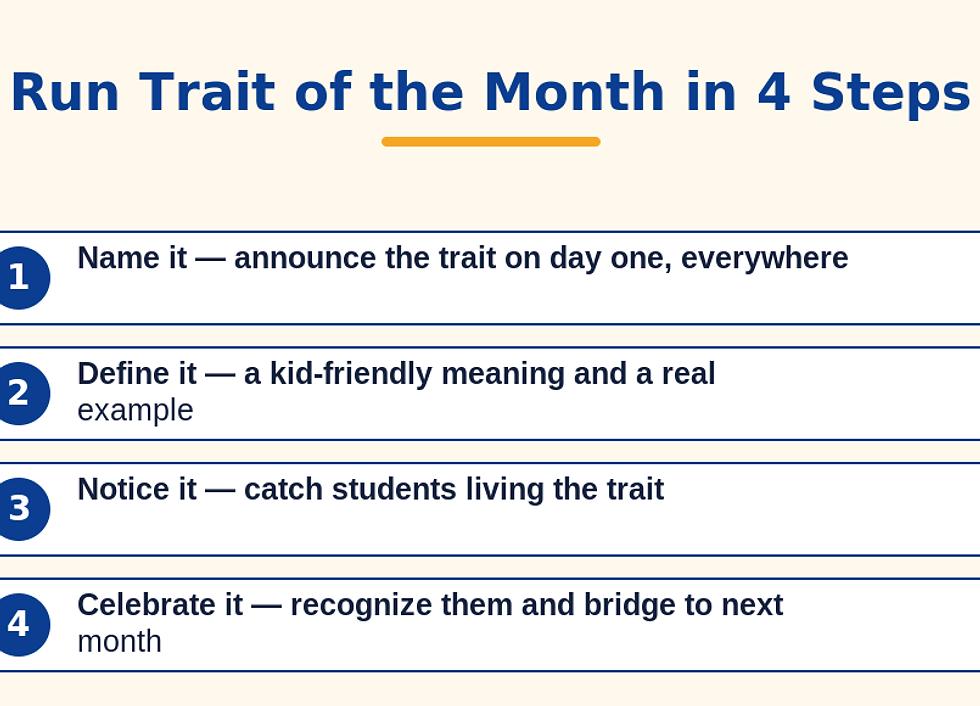
How to run trait of the month in four simple steps
Name it. Announce the trait on day one — morning announcements, a hallway banner, a slide in every classroom.
Define it. Give a kid-friendly definition and one concrete example of what it looks like in your building.
Notice it. Ask staff to “catch” students showing the trait and hand out a quick recognition — a shout-out, a ticket, a note home.
Celebrate it. Close each month by naming a few students who lived the trait, and connect it to the next one.
How do you make the traits actually stick?
The calendar is the skeleton; repetition is the muscle. Traits stick when adults model them, when the language shows up everywhere, and when students get a memorable launch. That launch is where a live event helps most — a character education assembly can introduce the year’s traits with music and energy that a slideshow can’t match, and then your monthly routine keeps the message alive. If you’d like that kind of kickoff, you can bring a character-building assembly to your school, or simply run the calendar yourself — both beat doing nothing.
Frequently asked questions
Do we have to use these exact traits? No — swap in whatever matches your school’s mission or PBIS words. The cadence matters more than the specific list.
What ages does this work for? K–8. Younger grades lean on stories and songs; older grades respond to real dilemmas and student-led discussion.
How do we know it’s working? Watch your discipline referrals, listen for the trait’s language in the halls, and ask teachers whether students are naming the value on their own.
What if we miss a month or fall behind? Don’t scrap the whole plan — just pick up where you are. Consistency over the year matters far more than hitting every date perfectly, and students benefit even from a partial run.
Start with one month. You don’t need a committee or a budget to begin — post September’s trait, tell your staff, and build from there. A year from now you’ll have a shared vocabulary your whole school speaks, and that’s the real goal.
References
Durlak, J. A., et al. (2011). The Impact of Enhancing Students’ Social and Emotional Learning: A Meta-Analysis. Child Development. casel.org
Belfield, C., et al. (2015). The Economic Value of Social and Emotional Learning. Center for Benefit-Cost Studies of Education, Columbia University. cbcse.org
National Center for Education Statistics (2024). Student Reports of Bullying: 2022 School Crime Supplement. nces.ed.gov
Character.org. The 11 Principles of Character. character.org
Written by Brian of Coast to Coast School Assemblies — a performing artist and educator who has brought character and reading programs to hundreds of elementary schools.


Comments