
Arts Integration Activities Any Teacher Can Try
Updated: Aug 28
Quick answer: Arts integration means teaching a regular academic subject through an art form — setting a science concept to a song, acting out a history scene, sketching a math idea, or moving to show a life cycle. You do not need any art training to do it. Start small with one music, drama, movement, or visual-art activity woven into a lesson you already teach, and you will see stronger engagement and recall without adding a separate subject to your day.
One honest note up front: we run interactive music assemblies and songwriting residencies, so we are big believers in the arts in school. But everything below works with any teacher leading it, and the research we cite comes from independent studies, not from us.
What is arts integration, exactly?
Arts integration is not the same as art class. In an art class, students learn about the art form itself. In arts integration, the art form becomes the vehicle for learning something else — students demonstrate their understanding of fractions, the water cycle, or a novel by making and sharing art. The academic goal stays front and center; the art is how they get there and how they show what they know.
That distinction matters because it means arts integration does not steal time from core content. You are still teaching the standard. You are simply using rhythm, story, image, or movement to help it stick. That is useful at a moment when the arts are thin on the ground: access to arts education has been declining steadily across US schools, and dedicated theatre and dance instruction reaches only a small share of schools. Integrating the arts into everyday lessons is one way to give students that creative experience anyway.
Why does arts integration work?
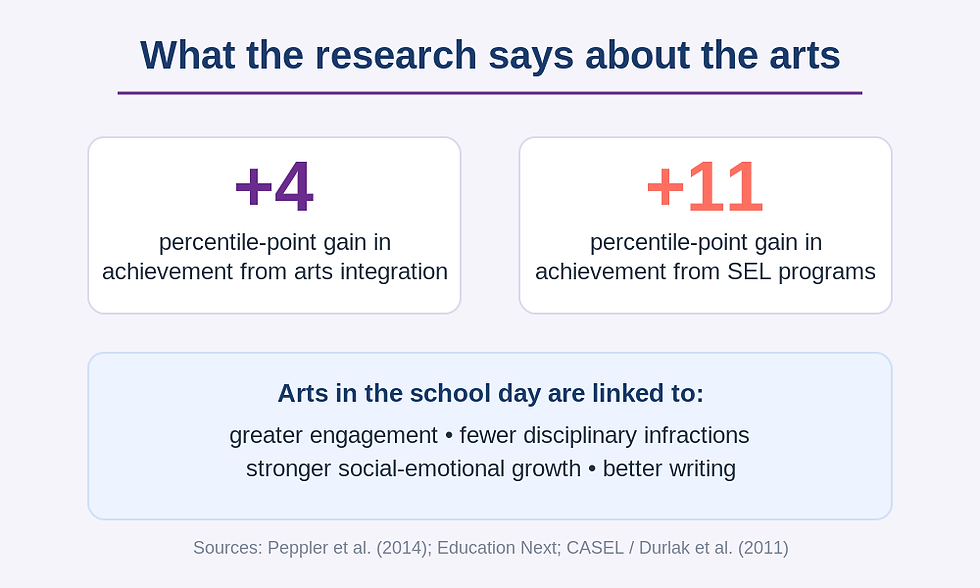
The short version: the arts pull students in, and engaged students learn more. A review of arts-integration research found that, on average, a child can gain about four percentile points in achievement from an arts-integration intervention — a meaningful bump for something that also makes class more fun. The gains tend to be largest for the students who are hardest to reach through traditional instruction.
The benefits go beyond test scores. When the arts are part of the school day, researchers have found students show greater engagement, fewer disciplinary infractions, stronger social-emotional growth, and better writing. And because arts integration naturally builds collaboration and self-expression, it reinforces the same skills as social-emotional learning — where a landmark meta-analysis found students gained an average of 11 percentile points in academic achievement. Fold the arts in and you are quietly working two goals at once.
10 arts integration activities any teacher can try
You can start tomorrow. None of these require special materials, an arts degree, or a big block of time — just a willingness to let students make something.
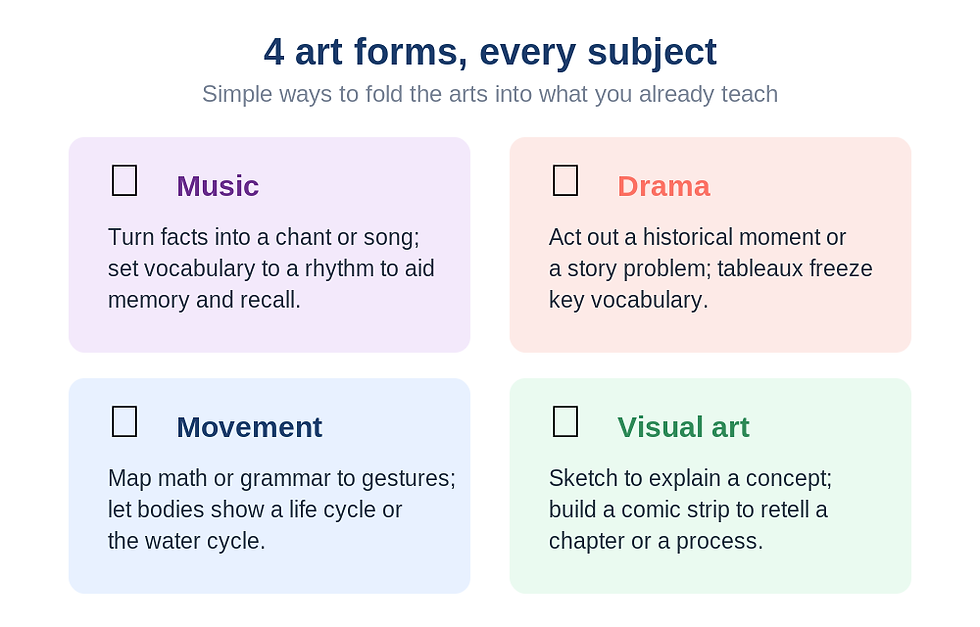
1. Turn facts into a chant or song. Set spelling words, the steps of long division, or the branches of government to a simple rhythm. Music activates attention, emotion, and memory at once, which is why it aids recall.
2. Freeze-frame history. Have small groups build a tableau — a frozen human picture of a key moment — then tap each student to say one line in character.
3. Sketch to explain. Instead of writing a definition, ask students to draw a quick visual that shows a concept. The drawing forces them to clarify their thinking.
4. Move the concept. Map math or grammar to gestures — arms wide for a right angle, a full-body wave for the phases of the moon. Movement gives abstract ideas a physical anchor.
5. Build a comic strip. Retell a chapter, a science process, or a historical event in six panels. Students plan sequence, cause, and effect while they draw.
6. Write a class song. Pick a topic and co-write two verses and a chorus about it; everyone contributes a line. This is the heart of what a songwriting residency builds around.
7. Soundtrack a scene. Ask students to choose or make sounds that match the mood of a passage. It builds inference and vocabulary about tone.
8. Perform a how-to. Have students act out a process — photosynthesis, a word problem, the life of a butterfly — with each student playing a stage.
9. Poetry from data. After a unit, students distill what they learned into a short shape poem or found poem. It rewards precise word choice.
10. Gallery walk. Students post their visual work and walk to view each other’s, leaving one sticky-note comment per piece. It turns review into a shared, active event.
How do you start if you have no art background?
You already have everything you need. Arts integration is not about polished performances or gallery-ready paintings; it is about using creative expression to deepen learning. Start with one art form you feel even slightly comfortable with — most teachers pick music or drawing — and add a single activity to one lesson this week. Keep the academic goal clear, let the product be rough, and focus on what students are thinking while they make it.
A few guardrails help. Give students a tight, specific prompt rather than a blank canvas. Set a short time limit so the activity supports the lesson instead of swallowing it. And judge the work by the understanding it reveals, not by artistic skill.
How does arts integration support SEL and reluctant learners?
Creative tasks give every student a way in. A child who freezes on a worksheet might light up when asked to draw, act, or add a beat — and that shift is not just morale, it is access to the content. Because arts integration invites students to share their own ideas and collaborate, it exercises self-awareness, teamwork, and perseverance right alongside the academics. Those are the same muscles that make music such a powerful hook for readers, which is why we built Rock Out For Reading around it.
For students who struggle academically or rarely raise a hand, the arts offer something worksheets often cannot: a chance to succeed publicly at something real. That small win can change how a child sees themselves as a learner, and it tends to carry into the parts of school that feel harder.
When is it worth bringing in a visiting artist?
Everyday classroom integration and a visiting-artist experience do different jobs, and they work best together. Your daily activities keep the arts woven through the curriculum. A visiting artist or songwriting residency raises the ceiling — a shared, high-energy experience that inspires students and leaves teachers with momentum to build on. Pairing the two, and reinforcing the calm-and-focus habits from our post on mindfulness activities for kids, gives students both the inspiration and the routine.
Frequently asked questions
What is the difference between arts education and arts integration? Arts education teaches the art form itself; arts integration uses an art form to teach another subject, like math or reading, while keeping the academic goal central.
Do I need art supplies or a budget? No. Most integration activities use only what you have — voices, bodies, paper, and pencils. The value is in the thinking, not the materials.
Will it take time away from test prep? It does not have to. Arts integration teaches the same standards through a different door, and research links it to higher achievement and engagement, not lower.
The bottom line
Arts integration is one of the most accessible, evidence-backed moves a teacher can make: it lifts engagement, supports SEL, reaches reluctant learners, and asks for almost no budget. Start with one activity this week, keep the academic goal in view, and let students make something. And when you want a live experience that ignites the whole school’s creativity, you can book an assembly or residency here.
References
Written by Andre — Coast to Coast School Assemblies. Brian and Andre have led interactive assemblies and artist-in-residence programs in schools since 1995. We have watched the arts reach kids nothing else could, and we cite a source whenever we share a number.


Comments