
Grants & Funding for School Assemblies: Where to Look
Updated: Aug 28
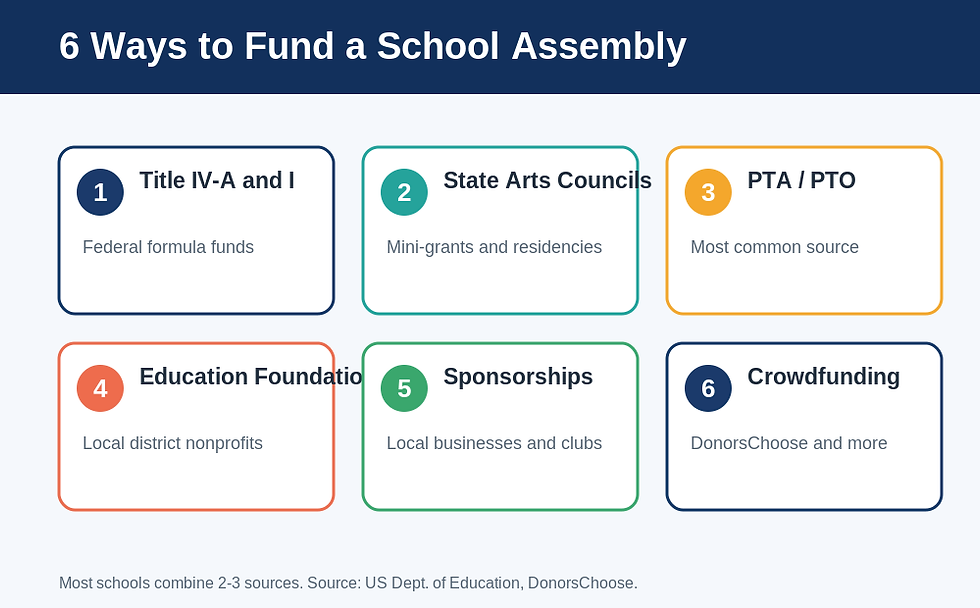
Quick answer: Money for a school assembly usually comes from a mix of sources rather than a single grant. The most common are federal formula funds (Title IV-A and Title I), state arts-council grants, your PTA or PTO budget, local education foundations, community and corporate sponsorships, and crowdfunding sites like DonorsChoose. Most elementary schools cover an assembly by combining two or three of these.
Full disclosure before we start: Coast to Coast is an assembly provider, so we clearly have a stake in helping you find the money. Everything below, though, is a public program or a general fundraising channel that is open to any school and any provider — including none at all. Our goal here is simply to point you to the doors worth knocking on.
Why does assembly funding feel harder to find right now?
Enrichment budgets have been squeezed for years. Access to arts education in U.S. public schools has been declining steadily according to the American Academy of Arts & Sciences, and the cuts fall hardest on low-income schools. Federal data show how narrow the pipeline can get: the share of schools offering theatre instruction dropped to roughly 4 percent, and dance to about 3 percent, by 2009-10. The pandemic-era ESSER relief funds that many schools leaned on have now largely expired, with the last obligation deadline passing in late 2024. The good news: several durable funding streams remain, and assemblies are usually an easy, low-cost line item to justify.
Which federal grants can pay for a school assembly?
Two federal formula programs are the workhorses. Title IV-A, the Student Support and Academic Enrichment grant, exists specifically to fund a well-rounded education — language that comfortably covers arts, character education, and social-emotional programming. It was funded at roughly $1.4 billion in FY2024. Ask your district's federal-programs coordinator how your building's Title IV-A allocation is being used.
Title I, Part A is the largest federal K-12 program and flows to schools serving students from low-income families. It can pay for enrichment when the activity is tied to your school's improvement goals — for example, a reading-motivation assembly that supports a literacy objective, or an anti-bullying program that supports a school-climate goal. The key phrase for both grants is alignment: write the assembly into the plan you already have, and connect it to a measurable goal.
Because these are formula funds already sitting in district accounts, they are often faster to tap than a competitive grant you have to win. If you are still comparing options, our guide to how much a school assembly costs can help you size the request before you ask.
What about state and local arts funding?
Every state has an arts council that regularly funds school residencies and performances, usually with support from the National Endowment for the Arts. Grant sizes and deadlines vary, but many councils offer small, fast-turnaround "mini-grants" designed for exactly this kind of one-day program. Search your state's name plus "arts council teaching-artist grant."
Closer to home, local education foundations — the nonprofit arms attached to many districts — award classroom and school grants every year, and community service clubs (Rotary, Kiwanis, Lions, Elks) frequently sponsor a youth event when a principal or PTA officer simply asks. These local asks are underused and often the quickest yes.

Can your PTA or PTO cover the cost?
Very often, yes — and it is the single most common way assemblies get paid for. Parent groups raise money precisely to fund experiences the school budget cannot, and a whole-school assembly is a visible, popular use of those dollars. If your PTA's fall fundraiser lands before your assembly date, earmark a portion up front. Pairing the assembly with a back-to-school kickoff gives parents a concrete, exciting reason to give.
How do crowdfunding and sponsorships fit in?
Crowdfunding has become a serious channel. On DonorsChoose alone, donors have contributed more than $1.64 billion across 2.95 million classroom projects, with 88 percent of U.S. public schools participating as of mid-2024. A well-written project that explains the "why" of your assembly — the reading slump you're fighting, the kindness culture you're building — tends to fund faster than a bare supply list.
Local sponsorship is the other underrated option. Credit unions, pediatric dental practices, family restaurants, and regional employers will often underwrite a school event for modest recognition in the newsletter and on a banner. One or two $250-$500 sponsors can cover a program outright.
A simple plan to fund your next assembly
Price it first. Get a firm quote so you know the exact number to raise.
Check for formula funds. Ask your Title IV-A / Title I coordinator before writing any grant.
Tap the PTA/PTO. Request an earmark tied to a specific date and goal.
Add one local ask. A service club, education foundation, or business sponsor.
Fill the gap with crowdfunding. Post a project that leads with the student outcome.
Stack two or three of these and most schools reach their number without strain. When you're ready to lock a date, you can book a Coast to Coast assembly here and we'll send a quote you can drop straight into any of the requests above.
Frequently asked questions
Can Title I really pay for an assembly?
Yes, when the program supports a goal in your school improvement plan and serves the students the funds are meant for. Document the connection and clear it with your federal-programs coordinator.
Are ESSER funds still available?
For most schools, no. The federal relief funds that covered many enrichment programs during the pandemic reached their final obligation deadline in late 2024, so plan around the durable sources instead.
What's the fastest source?
Usually your PTA/PTO or an existing Title IV-A allocation, because the money already exists — you're redirecting it, not competing for it.
How do you write a funding request that gets a yes?
Decision-makers say yes faster when you make the choice easy. Lead with the student outcome, attach one measurable goal, and give an exact number so no one has to guess. A single clear page beats a long proposal every time.
Name the outcome first. "Boost reading motivation for our K-2 students," not "hire a performer."
Tie it to a goal you already have. Reference your school improvement plan or climate goal by name.
Give the exact cost and date. A firm quote and a proposed date remove friction.
Keep it to one page. Decision-makers skim; make the ask impossible to miss.
If you're comparing formats, a lively, curriculum-connected program like our Rock Out For Reading assembly is easy to justify because it maps directly onto a literacy objective. Reviewers fund outcomes, not entertainment, so lead with the learning.
Should you stack an assembly with a residency?
If you win a larger grant, consider pairing a one-day assembly with a follow-up residency or workshop so the message keeps working after the performers leave. Federal Title IV-A funds and state arts-council grants both allow multi-visit programming, and the deeper engagement often makes a stronger case on next year's renewal. Start small, prove the impact, and scale the ask.
Where should you look first?
Start with the money that already exists in your building before chasing anything competitive. That usually means asking your federal-programs coordinator how your Title IV-A and Title I dollars are allocated, then checking your PTA or PTO balance. Those two conversations resolve funding for a surprising number of schools in a single afternoon. Only reach for grants and crowdfunding once you know the size of the gap you actually need to close.
References
Written by Andre — Coast to Coast School Assemblies. Andre and Brian have performed interactive school assemblies and residencies for elementary students across the Northeast and nationwide since 1995. We share funding tips from 25+ years of helping schools bring programs to life. When a number matters, we cite the source.


Comments