
Hispanic Heritage Month Ideas for Schools
- songspun
- 22 hours ago
- 6 min read
By Brian · Coast to Coast School Assemblies
Quick answer: The best Hispanic Heritage Month ideas for schools go deeper than a food-and-flags week. Run it from September 15 to October 15, connect it to real people and stories, and let Hispanic students and families lead rather than be put on display. Try author studies and bilingual read-alouds, a "heritage in our community" interview project, art and music from specific countries, a family recipe-and-story night, and a schoolwide assembly to launch it. Focus on depth over decoration, celebrate contributions all year, and keep the tone one of respect, not tokenism.
When is Hispanic Heritage Month and why those dates?
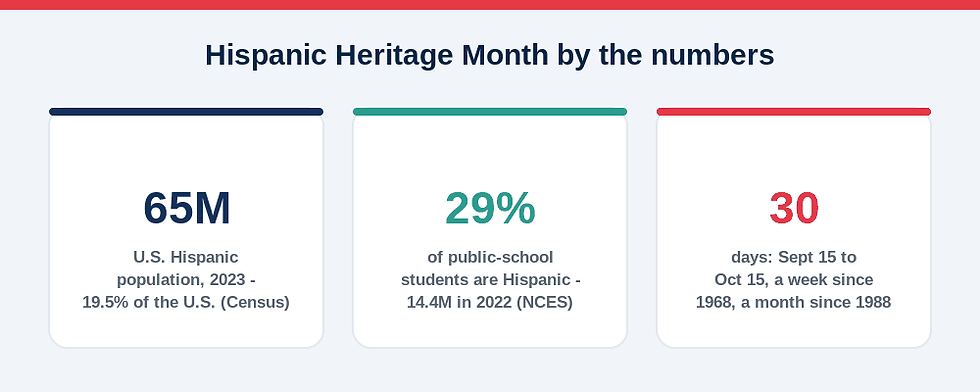
Hispanic Heritage Month runs September 15 to October 15 — a 30-day window that famously starts in the middle of a month rather than the first. It began in 1968 as Hispanic Heritage Week under President Lyndon Johnson and was expanded to a full month in 1988, signed into law by President Ronald Reagan (National Archives). Knowing the story behind the dates turns a calendar box into a genuine teaching moment.
The start date is deliberate. September 15 is the anniversary of independence for five Latin American countries — Costa Rica, El Salvador, Guatemala, Honduras, and Nicaragua, which all declared independence from Spain on September 15, 1821. Mexico's independence day follows on September 16 and Chile's on September 18 (Library of Congress). That clustering of independence days is exactly why the month begins mid-September, and it is a great hook for a first-day lesson.
Why does Hispanic Heritage Month matter in schools?
Because it reflects a huge and growing share of the students in the room. The U.S. Hispanic population reached just over 65 million in 2023, about 19.5% of the country and the second-largest group after non-Hispanic White Americans (U.S. Census Bureau). This is not a niche observance — it speaks to nearly one in five people in the country.
In classrooms the share is even larger. Of the 49.6 million students in U.S. public schools in fall 2022, some 14.4 million — 29% — were Hispanic/Latino, up from 24% just a decade earlier (NCES). For millions of students, this month is a chance to see their own heritage honored at school; for everyone else, it is a window into cultures they share a country with. Both matter, and the research on belonging is clear that students who feel seen engage more.
What are the best classroom activities?
These go beyond decoration and put real stories at the center. Pick a few and do them well rather than cramming all thirty days.
Author and illustrator studies. Read books by Hispanic and Latino authors — picture books, poetry, middle-grade novels. Let students meet the culture through voices from inside it, not a single overview lesson.
Bilingual read-alouds. Share stories in Spanish and English, and invite bilingual students or families to read. It signals that speaking two languages is an asset, not a hurdle.
"Heritage in our community" interviews. Students interview a family or community member about their background and present what they learned. This roots the month in real people students actually know.
Country deep-dives. Assign small groups a specific country — its music, art, geography, and a notable figure — instead of treating "Hispanic" as one thing. The diversity is the lesson.
Art and music from a specific place. Explore Mexican muralism, Puerto Rican bomba, Andean instruments, or Dominican merengue. Hands-on making beats a worksheet every time.
For older students, push past introductions into substance. Middle and high schoolers can research Hispanic scientists, writers, athletes, and civil-rights leaders and present short "who shaped this field" profiles; analyze a poem or song lyric in both languages; or map the immigration and independence history behind the month's dates. The aim at every age is the same — move from "we noticed this culture" to "we understand something real about specific people and places."
If you want the month to feel connected rather than one-off, our multicultural assembly ideas to celebrate diversity pair naturally with these classroom activities.
How do you avoid tokenism?
This is the part schools most often get wrong, so it is worth being direct. Tokenism is when a culture shows up as decoration — a food day, a flag, a poster — and then disappears on October 16. A few principles keep the month meaningful.
Let Hispanic students and families lead, not perform
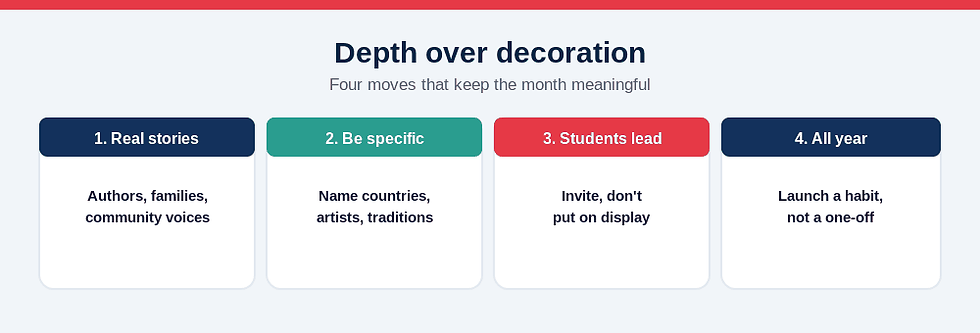
There is a big difference between inviting families to share and putting students on the spot as cultural exhibits. Offer chances to contribute, make them optional, and never assume a Latino student wants to be the spokesperson for an entire heritage. Leadership feels like respect; obligation feels like a spotlight.
Go specific, not generic
"Hispanic" spans more than 20 countries and countless distinct cultures. Naming a specific place, artist, or tradition — and noting the differences between them — teaches far more than a blur of maracas and sombreros. Specificity is the single best antidote to stereotype.
Connect it to the whole year
The strongest programs treat September 15 as a launch, not the whole story. Feature Hispanic authors in your classroom library year-round, keep community voices in the building past October, and let the month kick off a habit rather than close a box. Our year-round heritage month calendar shows how to spread this across the whole school year.
How do you celebrate the whole school at once?
A schoolwide moment ties the classroom work together and signals that this matters to the whole community. A kickoff assembly on or near September 15 — live music, storytelling, a performer who brings energy and specifics rather than clichés — launches the month with something students remember. The key is that the event connects to the deeper classroom work rather than replacing it. Our GatherHere cultural celebration assembly is built to honor heritage with real substance, and you can book a school assembly to anchor your Hispanic Heritage Month.
Beyond the assembly, schoolwide touches keep the energy up: a "voices" bulletin board featuring Hispanic authors, scientists, and artists; a family heritage night with food and stories shared by the families themselves; morning announcements spotlighting a different country each day; and student-created work displayed where the whole school sees it. The goal is a month that feels owned by the community, not staged for it.
Frequently asked questions
Should we say Hispanic or Latino? Both are used, and preferences vary by person and community. "Hispanic" refers to Spanish-speaking heritage; "Latino/Latina/Latine" refers to Latin American origin. The federal observance uses "Hispanic." When in doubt, ask individuals how they identify — that respect is itself the lesson.
What if we have few Hispanic students? The month still belongs in your school. It is a window for all students into cultures they share a country with, and the history and contributions are part of everyone's American story. Just avoid singling out the few Hispanic students to represent an entire heritage.
How do we keep it from being just a food day? Food is a fine doorway, but pair it with stories, authors, history, and specific countries. Ask "what did students learn about real people and places?" If the answer is only "they tried a new snack," go deeper.
Do we have to fit everything into 30 days? No — and you should not try. Treat September 15 as a launch and carry Hispanic voices into your library, curriculum, and celebrations all year long.
References
National Archives. Hispanic Heritage Month — history (1968 week under Johnson; expanded to a month in 1988 under Reagan). archives.gov.
Library of Congress. National Hispanic Heritage Month — legislative history and the September 15 independence anniversaries (Costa Rica, El Salvador, Guatemala, Honduras, Nicaragua; Mexico Sept 16; Chile Sept 18).
U.S. Census Bureau. Hispanic population reached ~65 million in 2023 (19.5% of the U.S.). census.gov.
National Center for Education Statistics (NCES). Racial/Ethnic Enrollment in Public Schools — Hispanic students 14.4 million (29%) in fall 2022, up from 24% in 2012. nces.ed.gov.
About the author: Brian is a presenter with Coast to Coast School Assemblies, so read the assembly section knowing we sell the thing we are recommending. That is also why most of this guide is free classroom work — author studies, interviews, family nights, and country deep-dives cost nothing and carry the real weight of the month. An assembly is a spark for a celebration your community leads, never a substitute for it.


Comments