
How to Motivate Reluctant Readers: 12 Teacher Tips
Updated: Aug 28
Quick answer: To motivate reluctant readers, give kids genuine choice, shrink the goal until success feels easy, read aloud daily, and connect books to what they already love. Motivation grows from small, repeated wins — not pressure. Below are 12 classroom-tested tips, grounded in research showing that reading volume, not lecturing, drives growth.
Why are so many kids reluctant to read?
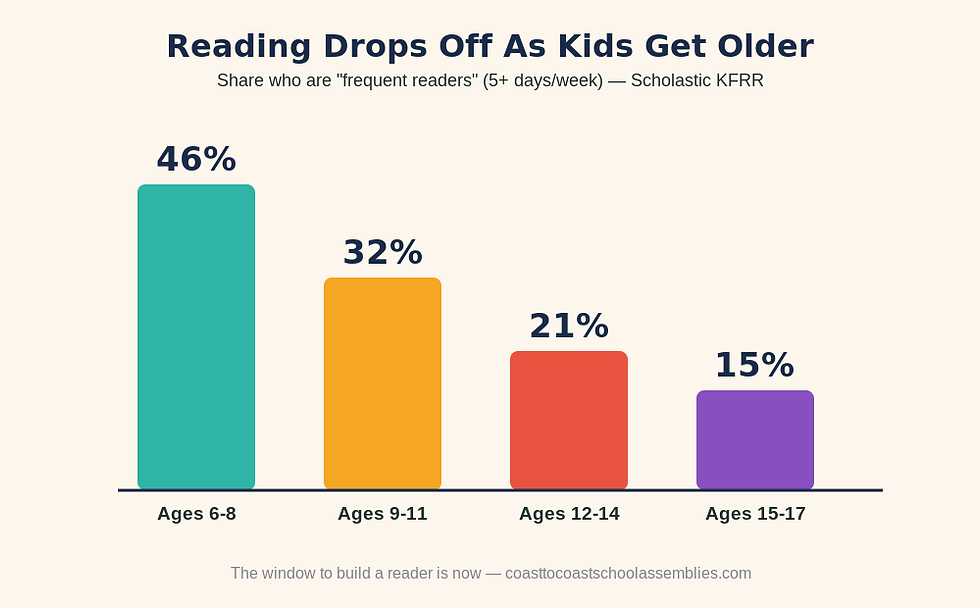
Reluctance is rarely about ability — it is usually about experience. As kids get older, reading often becomes something assigned rather than chosen. Scholastic’s data shows frequent reading falls from 46% of 6–8-year-olds to just 15% of teens. Meanwhile, fewer than half of parents read aloud daily, dropping to only 17% by ages 9–11. The habit erodes right when independence should be taking over.
The stakes are real: in 2024, 40% of fourth-graders read below the NAEP Basic level (NCES). But motivation is fixable, and it starts with how reading feels.
What are the 12 best ways to motivate reluctant readers?

Give real choice. Let kids pick their own books — autonomy is the single biggest motivator.
Let them abandon books. Quitting a boring book is what real readers do; it is not failure.
Read aloud daily. Kids read to daily are nearly three times as likely to choose reading on their own.
Shrink the goal. “Read 10 minutes” beats “read a chapter” for a hesitant child.
Try graphic novels. They are real reading and often the on-ramp for a struggling reader.
Make it social. Buddy reading, book clubs, and partner recommendations lower the pressure.
Model your own reading. Let students see you read and hear what you love about it.
Follow their interests. Sports, animals, gaming — match books to what already lights them up.
Count audiobooks. Listening builds vocabulary and story love; it is a legitimate path in.
Celebrate volume, not just level. Praise how much they read, since minutes drive growth.
Add a live spark. A reading assembly can reset a whole grade’s attitude in 40 minutes.
Never use reading as punishment. Assigning pages as a consequence teaches kids that books are the bad guy.
Why does volume matter more than pressure? Because of the Matthew Effect: kids who read more get better, which makes them want to read more. Anderson, Wilson & Fielding found top readers log about 200 times more reading minutes per day than the most reluctant readers. Every tip above is really a strategy to raise minutes.
How do you help a reluctant reader without making it a battle?
Lead with connection, not correction. Notice what a child is drawn to, hand them a book that matches, and keep the first goal absurdly small. Protect reading from becoming a chore — no reading as punishment, no shaming slow progress. When kids associate books with comfort and choice, resistance fades.
A shared, school-wide event can accelerate this. Our overview of reading assemblies that get kids excited to read explains how a live program gives every classroom a common spark to build these habits on.
What role can a school-wide event play?
Individual encouragement works, but culture is contagious. When an entire school celebrates reading at once — through a live literacy assembly program — reluctant readers stop feeling singled out and start feeling swept along. Pair the event with the classroom tips above and the effect compounds.
Frequently asked questions
At what age should I worry about a reluctant reader? Focus less on age and more on trend. If interest is steadily dropping, act early with choice and read-alouds.
Do rewards work for reading motivation? Small, low-stakes recognition can help, but intrinsic motivators — choice, interest, autonomy — last far longer.
How much daily reading should I aim for? Start with 10–15 minutes of self-selected reading and build from there; consistency beats length.
Want to give your whole school a reading reset? You can book a school assembly with Coast to Coast and we’ll send classroom follow-up ideas to match.
References
National Center for Education Statistics (NCES), 2024 NAEP Reading Assessment — nationsreportcard.gov
Scholastic Kids & Family Reading Report, Finding Their Story (7th ed.)
Anderson, Wilson & Fielding (1988), Growth in Reading and How Children Spend Their Time Outside of School, Reading Research Quarterly
About the author: Brian is a presenter with Coast to Coast School Assemblies. Honest disclosure: we run live literacy and character assemblies, so this topic is close to our work — but every figure here comes from independent, publicly available research you can check at the sources above.


Comments