
Red Ribbon Week Ideas & Activities (Plan Early)
Quick answer: Red Ribbon Week runs October 23–31 every year, and more than 80 million young people and adults take part. The schools that get the most out of it decide on a theme by June, book any outside speaker or assembly before summer break, and build the week around what students are already doing right rather than around fear.
What is Red Ribbon Week, and when is it?
Red Ribbon Week is the nation's oldest and largest drug-use prevention awareness campaign. The dates are fixed: October 23 through October 31, an eight-day observance coordinated each year by the National Family Partnership. According to the Drug Enforcement Administration, more than 80 million young people and adults mark it annually by wearing or displaying a red ribbon and committing to a drug-free life.
Because the dates never move, October fills up fast — and it collides with National Bullying Prevention Month. If your building wants both a Red Ribbon kick-off and a climate assembly in the same month, that calendar conversation belongs in spring, not August. Our National Bullying Prevention Month planning checklist covers how schools typically sequence the two.
Why does the history matter to kids?
Because it is a true story about one person, and children remember people better than slogans.
Enrique "Kiki" Camarena was born in Mexicali in 1947, graduated from Calexico High School in California, served in the Marine Corps, and joined the DEA in 1974. Working out of Guadalajara, he spent more than four years tracking Mexico's largest marijuana and cocaine traffickers. In early 1985 he was close to exposing a multi-billion-dollar drug pipeline. On February 7, 1985, on his way to lunch with his wife Mika, five armed men forced him into a car. His body was not found until March 5. He was 37, and he left three sons.
Shortly afterward, Congressman Duncan Hunter and Kiki's high school friend Henry Lozano launched Camarena Clubs in Calexico. Members wore red ribbons and pledged to live drug-free. In 1985, club members presented a Camarena Club Proclamation to First Lady Nancy Reagan. The campaign was formalized in 1988 by the National Family Partnership, with President and Mrs. Reagan as honorary chairpersons.
For elementary students, the honest version is short: a man did a dangerous job to keep kids safe, people wore red ribbons to say thank you, and we still wear them. That is enough. Save the details for middle school.
What does the data say about students today?
It says something most Red Ribbon assemblies get backwards. The 2025 Monitoring the Future survey — 23,726 students in 270 public and private schools, funded by the National Institute on Drug Abuse — found that 91 percent of eighth graders, 82 percent of tenth graders, and 66 percent of twelfth graders reported abstaining from marijuana, alcohol, and nicotine entirely in the past 30 days. Abstention has held near record highs for five consecutive years.
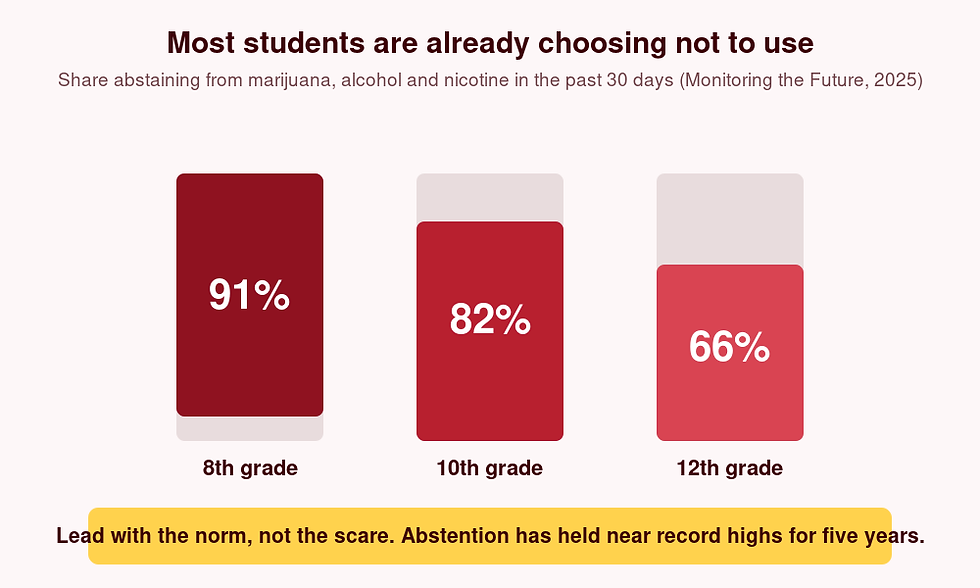
The specifics: 11 percent of eighth graders reported any alcohol use in the past 12 months, 8 percent reported cannabis, and 9 percent reported nicotine vaping. Rates rise with grade — 41 percent of twelfth graders reported past-year alcohol use — but the elementary and middle-school reality is that the overwhelming majority of students in your gym have never used anything.
Tell them that. Social-norms messaging — "almost everybody here is already choosing not to" — is one of the few things research consistently supports. A student who believes most peers use is more likely to try; a student who knows most peers do not is less likely.
What kinds of Red Ribbon activities actually change behavior?
A systematic review of school-based drug prevention programs identified a set of features that separate the programs with measurable effects from the ones that mostly feel good. Interactive delivery outperforms lecture. Programs grounded in the social influence model — norms, resistance skills, and commitment not to use — outperform information-only approaches. Peer leaders outperform adults alone. Adding community components and life-skills instruction strengthens effects. Assemblies alone do not change behavior; assemblies that launch a sustained classroom sequence can.
Practically, that means:
Pair the assembly with the week, not the other way round. The kick-off event sets a shared reference point; the classroom follow-up does the work.
Use student leaders. Fifth graders running the pledge table beats a principal running it. Middle schoolers presenting to third graders beats either.
Practice refusal out loud. Role-play, not a worksheet. Two minutes, twice.
Send something home. A family pledge card that a parent signs turns one week into one conversation at a kitchen table.
Connect it to character work you already do. Red Ribbon Week is about decision-making under pressure — the same muscle as our character education assembly guidance and the upstander skills in our anti-bullying activities roundup.
An eight-day theme plan

Oct 23 — Wear Red Day. Kick-off assembly, whole-school pledge signing, ribbons distributed.
Oct 24 — Team Up Against Drugs. Jersey day. Each class writes and posts one team pledge.
Oct 25 — Kiki Camarena Day. Read his story at an age-appropriate level. Older students write thank-you notes to local first responders.
Oct 26 — Sock It To Drugs. Crazy sock day, plus peer-led skits from a fifth-grade or middle-school team.
Oct 27 — My Future Is Bright. Sunglasses day. Goal-setting: one thing I want to be doing in ten years.
Oct 28 — Refuse To Use. Grade-banded refusal-skill role-play. Ten minutes, out loud, in every classroom.
Oct 29 — Hats Off To Being Free. Hat day. Family pledge card goes home.
Oct 30 — Community Day. Guest speaker, or a service project connected to the school's neighborhood.
Oct 31 — Say Boo To Drugs. Ribbon wall unveiled with every student's signature. Celebrate the week.
How do you plan Red Ribbon Week early?
Work backward from October 23. In April, name a staff lead and pick your theme. In May, decide whether you want an outside assembly, a speaker, or a fully in-house week. In June, book it — October dates are gone by late summer. In August, brief teachers with the daily plan and the follow-up activities. In September, send the family letter. By the time the ribbons go up, the week should already be running itself.
Honest disclosure: we perform school assemblies, so we have a stake in you booking one. Plenty of excellent Red Ribbon Weeks involve no outside performer at all. If you do want a kick-off event, you can book a school assembly with us, or use the same questions on anyone else.
Frequently asked questions
Is Red Ribbon Week only for older students?
No, but the content should change sharply by age. For K–2, it is about healthy choices and asking a trusted adult. For grades 3–5, it can include the Camarena story and refusal skills. Substance specifics belong in middle school and up.
Does scaring kids work?
The evidence does not support it. Reviews of school-based prevention consistently find information-and-fear approaches weaker than interactive, norms-based, skills-focused ones. Given that 91 percent of eighth graders are abstaining already, the accurate message is also the more effective one.
What if our school cannot afford an assembly?
Then run the week without one. A peer-led pledge campaign, five classroom role-plays, and a family letter cost nothing and hit more of the research-backed ingredients than a single lecture would.
Who sets the official dates?
The National Family Partnership, which has coordinated the campaign since 1988. The dates are October 23–31 every year and do not shift with the calendar.
References
U.S. Drug Enforcement Administration, The History of Red Ribbon Week — https://www.dea.gov/red-ribbon/kiki-red-ribbon-history
DEA, Get Smart About Drugs: Red Ribbon Week — https://www.getsmartaboutdrugs.gov/rrw
National Institutes of Health / NIDA, Reported use of most drugs remains low among U.S. teens (Monitoring the Future, December 17, 2025) — https://www.nih.gov/news-events/news-releases/reported-use-most-drugs-remains-low-among-us-teens
Cuijpers, P. Effective ingredients of school-based drug prevention programs: a systematic review. Addictive Behaviors, 2002 — https://pubmed.ncbi.nlm.nih.gov/12369469/
Written by Brian, Coast to Coast School Assemblies. We perform in schools during Red Ribbon Week, so treat this as informed advice from an interested party — every figure above links to its source.


Comments