
What Is Character Education? A Guide for Schools
Updated: Aug 28
By Andre · Coast to Coast School Assemblies
Quick answer: Character education is the deliberate, schoolwide effort to help students understand, care about, and act on core ethical values — respect, responsibility, honesty, empathy, and perseverance among them. It is not a single lesson or a hallway poster; it is a consistent approach woven through classroom culture, adult modeling, and real chances for students to practice good choices. Done well, it strengthens behavior, relationships, and academics at once — programs that build these social and character skills have been linked to an 11-percentile-point gain in academic achievement (Durlak et al., 2011).
What is character education, exactly?
Character education is the intentional teaching and cultivation of the values and habits that help young people live and work well with others. The field's most widely used framework, Character.org's Eleven Principles of Effective Character Education — first written by Thomas Lickona, Eric Schaps, and Catherine Lewis in 1995 — defines character comprehensively to include thinking, feeling, and behavior. In plain terms, a child of good character knows what is right, cares about doing it, and actually does it, even when no one is watching.
That three-part definition matters because it rules out the shortcuts. Handing kids a list of virtues to memorize touches only the knowing part. A one-time feel-good talk with no follow-up touches only the feeling part. Real character education connects all three: it gives students the language for values, the motivation to hold them, and repeated opportunities to act until the behavior becomes a habit. If you want to see what that looks like on stage and in the weeks after, our guide to what makes a great character education assembly walks through the difference between a performance and a program.
What is the difference between character education and SEL?
People often use character education and social-emotional learning (SEL) interchangeably, and in practice they overlap heavily. The cleanest way to tell them apart is by emphasis. Character education grows out of a moral and ethical tradition — it names virtues like honesty and responsibility and asks students to live them. SEL grows out of developmental psychology and organizes its work around five competencies defined by CASEL: self-awareness, self-management, social awareness, relationship skills, and responsible decision-making.
Look closely and the two blur together. Responsible decision-making is essentially moral reasoning. Social awareness includes empathy, a core character trait. Because the skills reinforce each other, most schools no longer choose between them — they run character education and SEL as one coordinated effort, and you can borrow SEL activities for the elementary classroom to put the values into daily practice.

Why does character education matter?
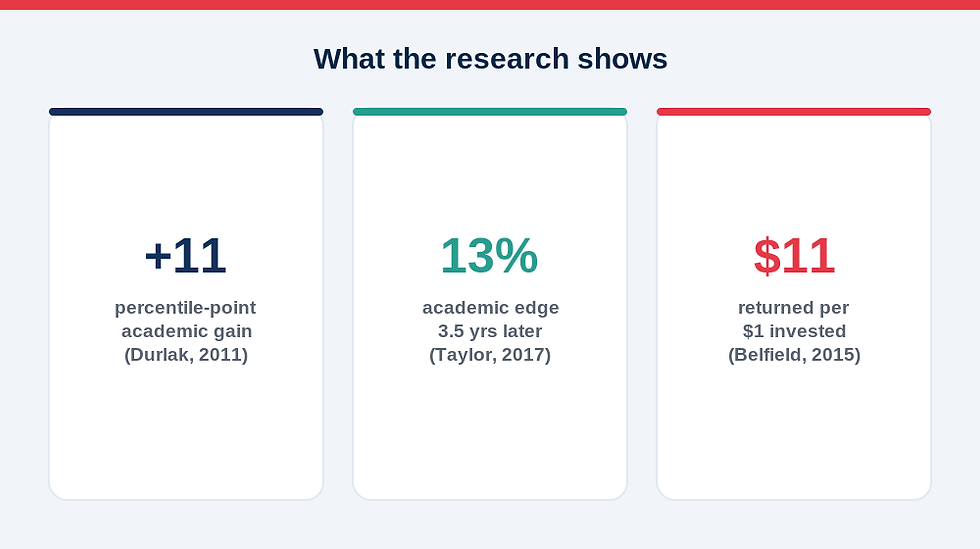
The case for character education is no longer just philosophical — it is empirical. The landmark review is Durlak and colleagues' 2011 meta-analysis in Child Development, which pooled 213 school-based programs serving more than 270,000 students. Students who took part showed better behavior, stronger attitudes, and academic performance that reflected an 11-percentile-point gain over peers who did not.
The benefits also last. A 2017 follow-up meta-analysis by Taylor and colleagues tracked 82 programs and 97,406 students and found that, an average of 3.5 years after the lessons ended, participants still showed a 13% edge in academic performance — along with better conduct and emotional health. Character skills, it turns out, do not wash out the way a memorized fact might.
There is a climate effect, too. Research compiled by the National School Climate Center links a positive, respectful school climate to higher achievement, better attendance, and fewer discipline problems. And the economics are striking: a 2015 benefit-cost study led by Clive Belfield at Columbia University found an average return of about $11 for every $1 invested in social and emotional programs.
What core traits does character education teach?
There is no single official list, but effective programs tend to circle the same durable virtues. Most schools choose a handful, define them in kid-friendly language, and revisit them all year — often as a trait of the month.
Respect — treating people, property, and yourself with care.
Responsibility — owning your choices and following through.
Honesty and integrity — telling the truth and doing right when it is hard.
Empathy and caring — noticing and responding to how others feel.
Perseverance and grit — sticking with a challenge past the first setback.
Fairness — playing by the rules and giving everyone a turn.
Courage — speaking up and standing for what is right.
Gratitude and self-discipline — appreciating others and managing yourself.
If you want a ready-made rotation, our 30 character trait of the month ideas and free calendar maps a full school year, and a schoolwide kindness challenge is an easy way to make the traits visible in the halls.

What does effective character education look like in practice?
The Eleven Principles distill decades of research into what separates programs that change behavior from posters that fade by October. A few stand out for busy schools.
Name a short list of core values and use them as the foundation for everything.
Be comprehensive and proactive — build character through academics, recess, and routines, not a single assembly.
Create a caring community where adults model the values they teach.
Give students real opportunities for moral action, from service projects to classroom jobs.
Foster self-motivation so students do right because they value it, not just to earn a sticker.
Involve the whole staff and families, and evaluate results honestly.

How do you start a character education program?
You do not need a big budget to begin — you need focus and consistency. Start by choosing three to five core values with staff and family input, so the language is shared from day one. Define each value in concrete, observable terms (what does respect look like in the cafeteria?), then weave them into morning meetings, read-alouds, and the way adults speak to students.
Next, give the values a launch and a rhythm. A live kickoff — an assembly, a spirit day, a schoolwide pledge — gets every student hearing the same message at once, and a monthly trait keeps it alive. Recognize students who model the values, loop in families with simple at-home prompts, and check your progress each semester with a quick climate survey. The goal is not perfection; it is a steady drumbeat that makes good character the norm.
What are the most common mistakes to avoid?
The two biggest pitfalls are treating character as an event and treating it as compliance. A single assembly with no classroom follow-up is a spark with no fire to catch it. And rewarding only obedience — rather than helping students understand why a value matters — produces behavior that disappears the moment the reward does. Effective programs favor reflection over rules, consistency over intensity, and adult modeling over lectures. Pair character lessons with your anti-bullying activities so students practice the values in the exact moments that test them.
How do assemblies fit into character education?
Assemblies are the launch, not the program. A great live experience does something a worksheet cannot: it gives an entire school a shared, emotional reference point — a song, a story, a moment — that teachers can point back to for months. That is why we design our Character Education & Anti-Bullying assemblies to hand teachers follow-up language and activities, so the energy from the gym turns into daily habits. When you are ready to give your program a schoolwide kickoff, you can book a school assembly and we will help you tie it to your core values.
How does character education change from kindergarten to fifth grade?
The core values stay the same from year to year; what changes is how you teach them. In kindergarten through second grade, character education is concrete and story-driven. Young students learn respect and kindness through picture books, puppets, role-play, and simple classroom jobs that let them practice responsibility in a way they can see and touch. Feelings vocabulary comes first, because a child cannot manage an emotion she cannot name.
By third through fifth grade, you can add nuance and independence. Students are ready to wrestle with gray-area dilemmas, discuss why a value matters rather than just that it does, and take on real leadership — running a service project, mentoring a younger class, or helping resolve a playground conflict. The shift is from following the rule to owning the reason behind it, which is exactly the self-motivation the research says makes character stick.
How do you measure whether character education is working?
Because character is about behavior, the best measures look at behavior and climate rather than a quiz score. Many schools track office discipline referrals, attendance, and bullying incident reports before and after launching a program, and pair those numbers with a short school-climate survey that asks students whether they feel safe, respected, and included. A rise in the survey scores alongside a drop in referrals is a strong signal the work is landing.
Keep the bar honest. Character education is a long game, so expect climate and behavior shifts within a semester and academic gains over years, not weeks. Watching the trend across a few simple, consistent measures beats chasing a single dramatic number — and it tells you which parts of the program to double down on.
What role do families and staff play?
Character education fails when it lives only in one classroom and succeeds when the whole community speaks the same language. That means every adult in the building — from the principal to the bus driver — models the core values, because students learn far more from what adults do than from what a poster says. Share the month's trait with staff so it shows up in hallway conversations, not just morning meeting.
Families are the multiplier. Send home a simple prompt or two — a question to ask at dinner, a small challenge tied to the trait of the month — so the value students hear at school gets echoed at home. When school and home reinforce the same message, children stop seeing character as a school subject and start seeing it as simply how their world works.
Character education versus discipline: what is the difference?
Discipline manages behavior in the moment; character education shapes the values that guide behavior when no adult is watching. A discipline system tells a student what will happen if he breaks a rule. Character education helps him understand why the rule exists and want to do right for its own sake. The two are not rivals — a school needs clear, fair consequences — but consequences alone teach compliance, not conscience.
The practical upside of leading with character is that it reduces the discipline you need. When students genuinely value respect and responsibility, small conflicts get resolved before they reach the office, and the climate research bears this out: schools with a strong, positive culture see fewer referrals and better attendance. Think of discipline as the guardrail and character education as teaching students to steer.
What does character education look like in one classroom?
Picture a week built around the trait respect. Monday opens with a two-minute morning meeting where students define what respect looks like in the hallway and at recess. Tuesday's read-aloud features a character who has to choose between fitting in and standing up for a friend, and the class discusses what respect required of her. Midweek, students catch each other being respectful and drop notes in a class jar.
By Friday, the teacher reads a few of the notes aloud, names the specific behavior each student showed, and connects it back to Monday's definition. Nothing here takes more than a few minutes a day, and none of it is a separate subject — it is woven into reading, meeting, and the ordinary business of the room. That is the whole method: small, consistent, and visible, until respect stops being a word on the wall and becomes how the class treats each other.
Frequently asked questions
Is character education the same as SEL? Not exactly. Character education emphasizes ethical values and moral action; SEL emphasizes five social-emotional competencies. They overlap so much that most schools run them together.
What grades is character education for? All of them. The values stay constant; the language and activities scale from kindergarten circle time to middle-school advisory.
Does character education actually raise test scores? Research links these programs to an 11-percentile-point academic gain (Durlak, 2011) and lasting effects years later (Taylor, 2017) — largely by improving climate, behavior, and engagement.
How long before we see results? Climate and behavior shifts often appear within a semester of consistent practice; the academic and long-term gains build over years.
References
Durlak, J. A., et al. (2011). The Impact of Enhancing Students' Social and Emotional Learning: A Meta-Analysis of School-Based Universal Interventions. Child Development, 82(1). srcd.onlinelibrary.wiley.com.
Taylor, R. D., et al. (2017). Promoting Positive Youth Development Through School-Based SEL Interventions: A Meta-Analysis of Follow-Up Effects. Child Development, 88(4). casel.org/2017-meta-analysis-summary.
Belfield, C., et al. (2015). The Economic Value of Social and Emotional Learning. Center for Benefit-Cost Studies of Education, Columbia University. cbcse.org.
Character.org. The 11 Principles of Effective Character Education. character.org.
CASEL. What Is the CASEL Framework? casel.org. National School Climate Center. schoolclimate.org.
About the author: Andre is a presenter with Coast to Coast School Assemblies. Honest disclosure: Coast to Coast provides live character education and anti-bullying assemblies, so we have a stake in this topic — but every statistic above is drawn from independent, publicly available research you can verify at the sources listed.


Comments